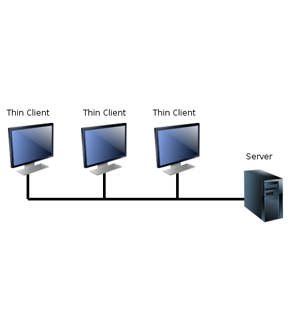


A thin client is a lightweight computer that is purpose-built for remoting into a server (typically cloud or desktop virtualization environments). It depends heavily on another computer (its server) to fulfill its computational roles. This is different from the traditional desktop PC (fat client), which is a computer designed to take on these roles by itself. The specific roles assumed by the server may vary, from hosting a shared set of virtualized applications, a shared desktop stack or virtual desktop, to data processing and file storage on the client or users behalf.
Thin clients occur as components of a broader computing infrastructure, where many clients share their computations with a server or server farm. The server-side infrastructure makes use of cloud computing software such as application virtualization, hosted shared desktop (HSD) or desktop virtualization (VDI). This combination forms what is known today as a cloud based system where desktop resources are centralized into one or more data centers. The benefits of centralization are hardware resource optimization, reduced software maintenance, and improved security.